When and How to Take Notes from Reading
Always get an overview of the material before taking notes. The more complex or lengthy the article, document, email chain, or book, the more critical it is to identify the key facts and information.
Three Key Stages
Gain a Visual Overview
‘Code Up’ the Information of Value
Harvest the Knowledge
Does This Apply to Both Work and Study?
Yes, the principles are the same. The only difference is that you may need to Harvest more detailed knowledge when studying. Well-structured, clear, and categorised knowledge is essential for learning, revision, and recall.
Stage 1: Gain a Visual Overview
This step is crucial for longer or more complex material, such as reports, presentations, email chains, or books. A quick overview will help you pinpoint the most valuable information.
Taking control: Your goal is to gain an overview and understand where the critical information might be.
Introductions and conclusions
The start and end of chapters or paragraphs
Highlights, bullet points, diagrams, and summaries
Time required: Spend 10–15 minutes getting this visual overview for longer material.
Stage 2: Decide on Your Approach
Once you’ve got the overview, decide whether you need to dive deeper into the material. Sometimes, a quick scan is enough to gather the key points.
Reading Sequence: You have three options—chronological, selective, or motivational.
Chronological: Best for shorter material, where reading in order makes sense.
Selective: Useful when only certain parts of the material are relevant.
Motivational: If you need to read everything, start with the easiest, shortest, or most interesting sections to build momentum. Save the longer or more challenging parts for later.
Stage 3: ‘Code Up’ the Valuable Knowledge
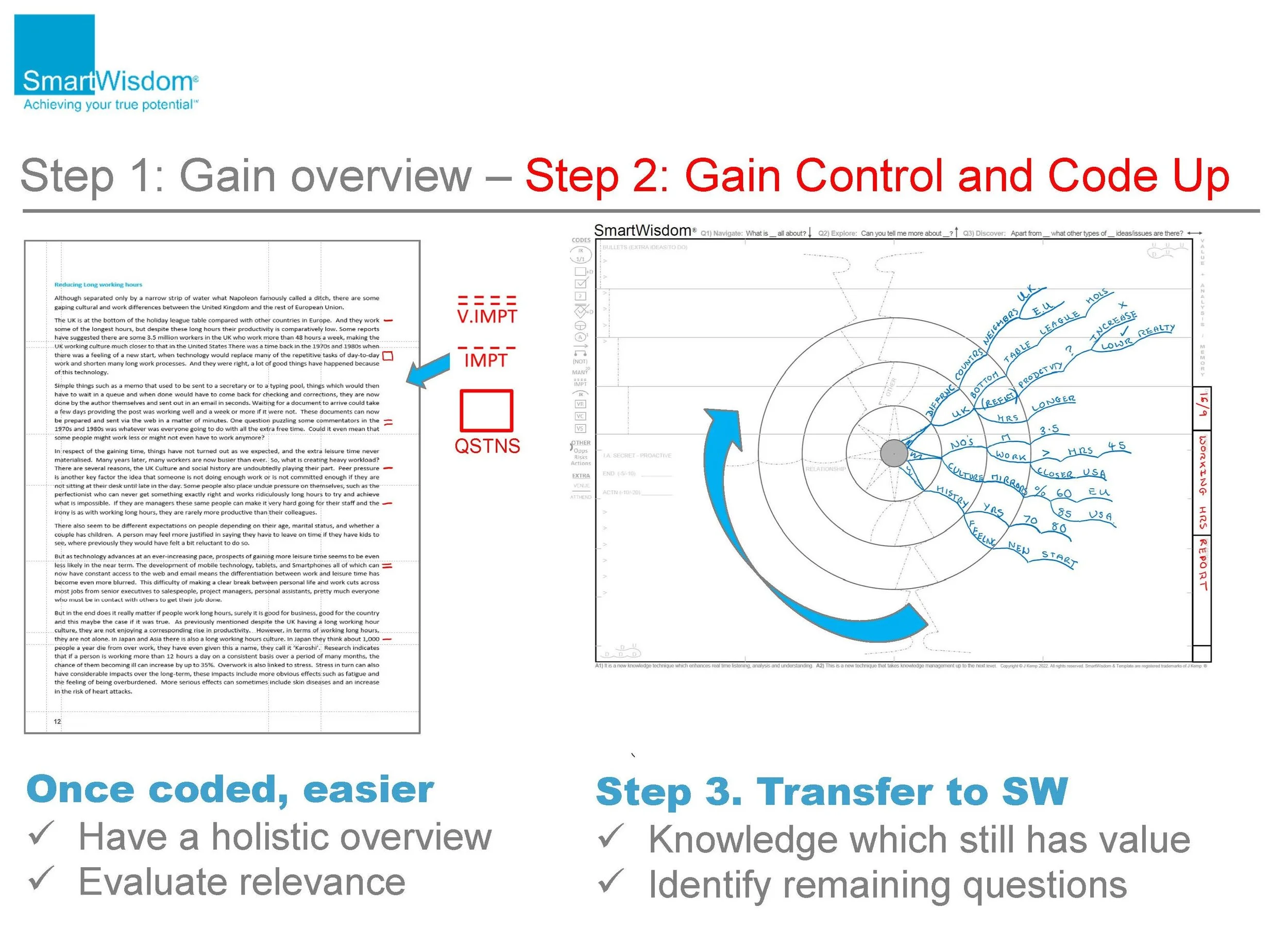
Avoid the temptation to start underlining or highlighting right away—it can slow down your reading and shift your focus away from understanding the content. Instead, try this more powerful approach:
Ask one question: What is or might be of value?
Use codes: Use simple codes to mark valuable information in the right-hand margins. If you're using SmartWisdom, the codes could be:
• Important = Single dash
• Very Important = Double dash
• Questions = Square boxRead at speed: If something doesn’t make sense or there are unfamiliar terms, just move on and continue reading. If it seems valuable, code it up.
Stage 4: Underline or Harvest the Knowledge
After coding the document, you’re now in control. You’ll have a good idea of what the material offers and what’s valuable. From here, you can decide:
You’ve got what you need: Sometimes, coding the material is enough to capture the key insights.
Underline critical points: If you feel certain parts need more attention, underline the crucial points to engage more with the content.
Harvest the knowledge: For deeper understanding, capture the vital knowledge by answering questions, clarifying terminology, and gaining more significant insights. While linear notes or bullet points might work, using SmartWisdom will give you even better results.